|
|
|
|


|
|
Rio Paciba Rio Pasimoni Venezuela 2007 |
||||||
| click photo for map | |||||||
|
Carry on up the Casiquiare |
|||||||
| Well, the best laid plans of mice and men . . . . . . . . . .The only affordable way for us poor Brits to reach the Pasimoni was to fly to Caracas, get an overnight bus to Puerto Ayacucho, and then travel a few hundred miles up the Orinoco, and down the Casiquiare. The trip up river was supposed to take 5 days, giving us 10 days fishing, then 5 days back to Puerto Ayacucho. Unfortunately there had been a drought. No rain for 2 months and the water levels were extremely low. Our progress up river was agonisingly slow, it took 14 days to reach the Pasimoni. All the river traffic had stopped, there was no ice, so no fresh meat, the drought had killed the Indians crops, so no vegetables to be bought, and we nearly ran out of fuel. We did eventually reach our destination, tired, frazzled, and hungry! |
 |
||||||
Caracas. We meet the other two members of our party; Gustavo a
Spanish Biologist, and Francesco a Venezuelan biologist. Friends of
Frank put us up in their flat overnight. Then our overnight bus to
Puerto Ayacucho.
|
 |
||||||
|
Puerto Ayacucho. A town that marks
some impassable rapids and the commencement of the Amazonas state.
This is Indian territory, and guarded by many army checkpoints.
Special permissions were required for us to travel further up the
Orinoco. (Click map for our route). This whole area seems to be
under total protection. |
 |
||||||
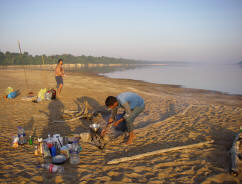
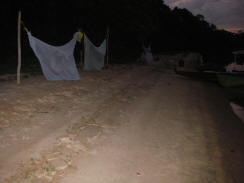
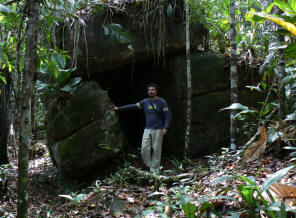
We set off with a Bongo, two Indian
boatmen and Pieter a German cook. We
travelled slowly up river, from bank to bank avoiding huge sandbars
and outcrops of Dali-esce rock formations. We slept in hammocks
strung from poles sunk into sandbanks. For day after day . . . . .
|
 |
||||||
| We stopped for a day on the Ventuari, and caught Cichla Intermedia, another sub species of Tucunare (Pavon in Venezuela) |
.JPG) |
||||||
|
We
carried on, up the Orinoco, past Yapacana Tepuis
and down the Casiquiare, both food and fuel running low. Rations were now pasta, tinned meat and piranha. We stopped off at Capybara, an abandoned Indian village, partially converted into a fishing lodge, then abandoned. A couple of guys had been left there as caretakers. We went fishing in a nearby lake for a day to save our sanity before we pressed on to the Paciba and Passimoni
|
 |
||||||
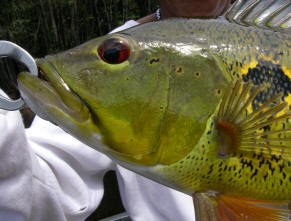
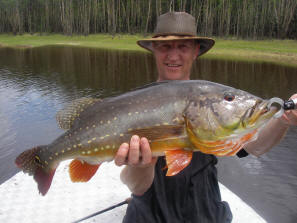
Then eventually we reached the Paciba.
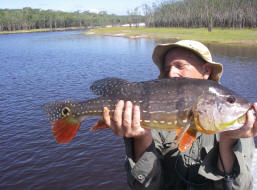
And the peacocks were getting bigger!
|
 |
||||||
Our stay at the Paciba was curtailed
as the crew got rather nervous after a jaguar prowled around our
camp during the night. We set off for the Pasimoni, stopping at a
Yamomami village to trade knives and provisions for bows and arrows.
|
 |
||||||
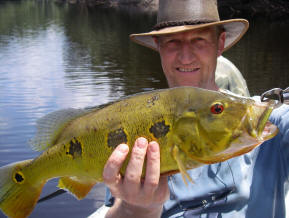
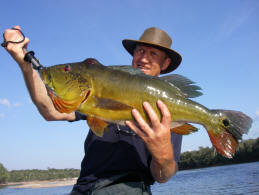
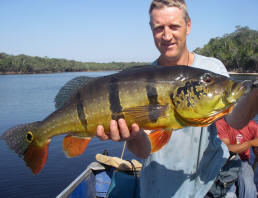
Finally
we arrived at the Pasimoni, tired, hungry, and Peacock Bass to 20lb !!!!!!!!!!
|
 |
||||||
After spending some 5 days fishing the
Pasimoni we had to think about getting back and catching our return
flights. We had not enough fuel to make the journey back down the
Orinoco, and nowhere near enough time. So we decided to carry on
down the Casiquiare in the launch (the bongo would not get past the
rapids at Solerno) and onto the Rio Negro to get a couple of light
planes out of San Carlos. How the crew were going to get the bongo
back to Puerto Ayacucho we didn't know and were past caring!
At the end of the trip we needed currency. Luckily our cook Pieter was closely associated with Coyote Expediciones. Luis from Coyote spent a whole day sorting us out, even though we were not his clients. I would strongly recommend anyone going to this area to use Coyote. |
 |
||||||

.JPG)


.JPG)
.JPG)


.JPG)