|
|
|
|


|
|
Lake Nicaragua Nicaragua 2008 |
|||
| click photo for map | ||||
|
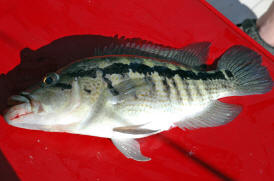
Cichlids in the sun |
||||
|
"Nicaragua has the largest tropical rain forest north of Amazonia, the most extensive seagrass pastures in the Western Hemisphere, the widest continental shelf, and stretch of coral reefs in the Caribbean, the longest river, largest lakes, richest volcanic soils, and least populous territory in Central America. Nicaragua has 100 species of freshwater fish, 200 species of mammals, 600 species of amphibians and reptiles, and 750 species of birds. It also has the most revolutions, civil wars, and foreign military interventions, and the longest reign of dictators of any country in Central America" (Nietshmann (1990). To this list could also be added that Nicaragua was -- and possibly still is -- a site for a trans-isthmus canal, has suffered numerous damaging earthquakes, has the largest island in a freshwater crater lake, has a diverse flora with at least 7,000 vascular plants and a variety of forest types, contains the most southerly extension of lowland pine forest in the hemisphere, and has had a long history of indiscriminate forest exploitation. By all standards, Nicaragua is quite a place. (BIODIVERSITY AND TROPICAL FOREST CONSERVATION, PROTECTION AND MANAGEMENT IN NICARAGUA: ASSESSMENT AND RECOMMENDATIONS /USDA Foreign Agricultural Service International Cooperation and Development )Its a big lake, lots of islands, lots of rivers an interesting array of fishes, and not a lot of information or fishing reports to be had. The TWAT's were embarking on our first exploratory! |
 |
|||
The infrastructure for the trip was
provided by the honourable Sir Martin Barnard of "No Frills" Fishing
Safari's in Los Chiles in the north of Costa Rica. We chose to go
with Martin as he is undoubtedly one of the best Tarpon guides
anywhere, has the best boats in the area and is a jolly good chap.
We took Julio, and Martilino and Lewis with us.
|
 |
|||
| Access to the lake is up the Rio Frio and over the border into Nicaragua. Lake Nicaragua or Cocibolca is a vast freshwater lake in Nicaragua. With an area of 3,191 sq mi, it is the largest lake in Central America, the 19th largest lake in the world. It is slightly smaller than Lake Titicaca. The lake reaches a depth of 85 ft. Home to Bull Sharks, Sawfish and Tarpon. |
 |
|||
|
First
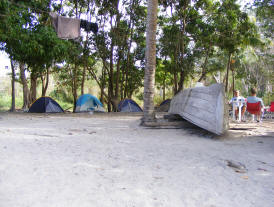
task is to find ourselves a campsite on one of the
Solentiname Islands. Not an easy job to find level land to camp
on, but eventually we found an excellent spot, and a convivial host
by the name of Luis. Luis was living alone, with two chickens, and
spent most of his time grating coconut.
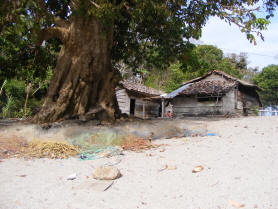
The photo shows Luis' house as it
was when we arrived, unfortunately after a bottle of FdC
|
 |
|||
ATime then
for some fishing, casting deep diving lures into the rocky shoreline
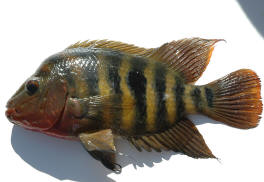
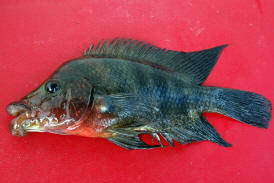
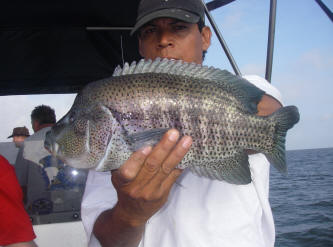
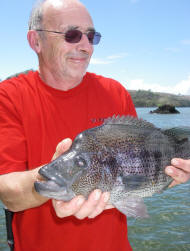
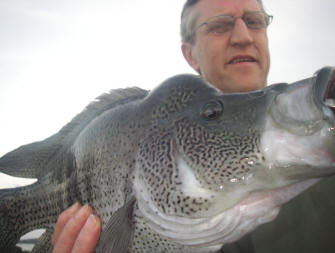
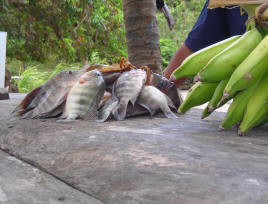
and reefs around the islands. A variety of Cichlids were caught, though none of any appreciable
size (we had set ourselves a target of a 10LB
Guapote) in truth the best we could manage was 4LB, still all
the fish were 'catchable' and colourful.
|
 |
|||
|
 |
|||
Whilst on the island we took a trip to
fish around the island of
Zanata, half way between the Solentiname Islands and Ometepe.
Unfortunately when we arrived we found the whole island literally
surrounded by nets. Not only illegal, but it prevented us from
getting anywhere near the shoreline to fish!! This may have given us
our first inkling that like everywhere else these days freshwater
environments are under too much pressure, locals can now get as much
as $10 for a large Guapote which ends up on the restaurant plates of
the burgeoning tourist trade in Granada
 |
 |
|||
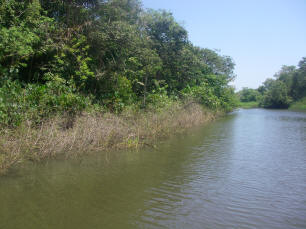
We also
took time to investigate one of the rivers running into the southern
shore of the lake. This didn't take as long as we had hoped, as
shortly after penetrating the river we were attacked by killer bees.
|
 |
|||
Then we
broke camp and made for
San Miguelito on the East shore of the lake, via San Carlos to
pick up supplies of food and ice. One of the outboards stopped
working, we tried to get it repaired, unsuccessfully, but we had two!
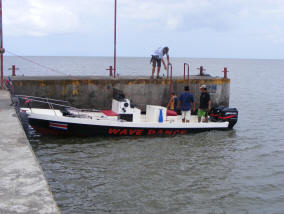
so we carried on to San Miguelito. Although it has a jetty, the
jetty was built for the lake ferry, not for small launches and we
had to beach the boats, amusingly for the locals we headed for a
small patch of level ground that turned out to be the sewage outlet
for the town! A pretty little town, and a decent bed for the night.
|
 |
|||
| We tried one of the rivers nearby on the east coast, no killer bees, but no fish either, and then the other outboard packed up, both engines dead. A day spent towing ourselves back out the river, down the lake, back through San Carlos and down the Rio Frio to Los Chiles where we awaited repairs, which involved bribing a mechanic to drive up from San Jose. We amused ourselves with a bit of angling on the Rio Frio for a couple of days whilst the entire wiring loom on the boat was replaced. |
 |
|||
Back
through the immigration office at Los Chiles, back up the Rio Frio,
through the Nicaraguan Army checkpoint, back through Immigration at
San Carlos (been there, done that, didn't bother with a T-shirt). We
headed full steam up the lake to the next set of islands and found
ourselves a 'Tropical Paradise'.The
island was inhabited by a couple of fishing families, they were
happy to see us (and our FdC ) and after donating Rice, Oil, Salt,
Tuna and other foodstufs the matriarch of the group looked after us
like a mother. Coffee was ready for us in the morning, all our food
was cooked, and the washing-up done. ) and after donating Rice, Oil, Salt,
Tuna and other foodstufs the matriarch of the group looked after us
like a mother. Coffee was ready for us in the morning, all our food
was cooked, and the washing-up done.
|
 |
|||
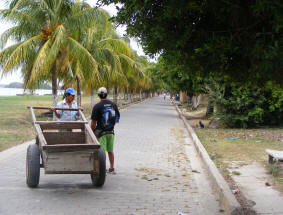
We visited another little town Morrito
to pick up supplies of Tobacco, luckily this time we could use the
jetty!
|
 |
|||
|
We fished
the island hard. Lots of fish, but again nothing sizable. After a
few days and the provision of more FdC it transpired that the local
families had not seen a large Guapote for 3 years. We tried another
river on the east shore, a local couple in a canoe told us 'No
molesta el Sabalo' - Duhh - us? what do you think we are trying to
do with 4 trolling rods out the back of the boat!!!! It turns out
that they are invaded by sport anglers coming over the lake from
Granada to fish for the Tarpon.
Then the winds started up. The Papaguyo winds. The lake when quiet and glass like is a paradise. When the winds blow it is a dangerous place to be. The winds did not subside, we decided to cut our losses and head back for a few days fishing down the Rio San Juan, and then back to the Rio Frio. |
 |
|||
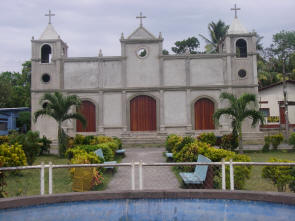
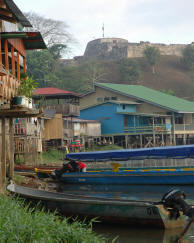
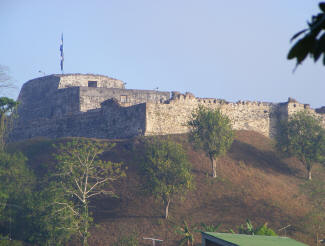
El
Castillo a real gem of a town, we fished the Pocosol, the Santa
Cruz, and Esquandito rivers. A few Gar and Machaca were landed.
|
 |
|||
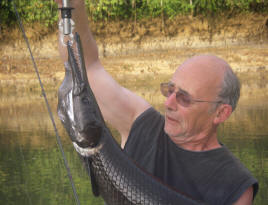
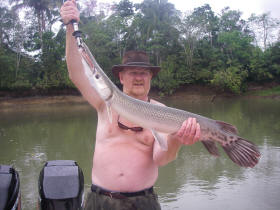
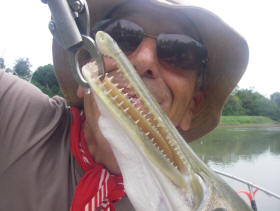
Then
finally back to the Rio Frio for a few days. We did hook up 3
Tarpon, but none landed, and its really the wrong time of year for
them, so we focussed on the Tropical Gar.
|
 |
|||
| And the biggest thing I caught was a Reptile!!!! - fairly caught mind! |
 |